


Nearly 100 residents of Taipei’s Huaguang Community (華光社區) and their supporters yesterday clashed with police outside the Executive Yuan during a protest against a forced demolition of their houses scheduled to take place next week.
“Premier, come out,” the residents and their supporters chanted as they pushed forward and clashed with police officers holding riot shields.
“The land on which our community stands used to be unwanted, but now that real-estate prices are going up, we’re facing forced eviction,” Chu Yi-chen (朱義珍) said. “We are not trying to make some illegal profits, we just want a home where we may stay without any worries.”
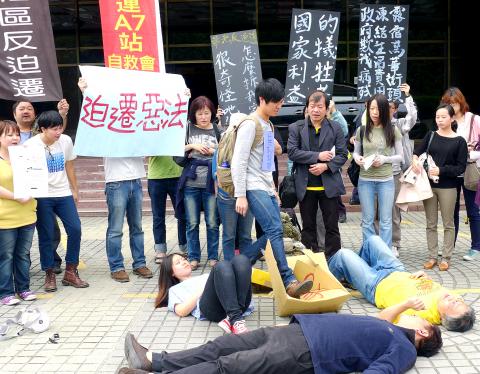
Photo: CNA
The residents are angry because despite their protests and petitions, the government has decided to start the demolition on Thursday and has filed lawsuits against residents for “illegally profiting” by occupying government property.
Chen Wei-hui (鄭偉慧), a resident and spokesman for the movement to save the community, said that in addition to some people who have lived in the community for generations, most of the residents are low-ranking soldiers who retreated to Taiwan with the Chinese Nationalist Party (KMT) regime in 1949 after it lost the Chinese Civil War against the Chinese Communist Party.
“They came with the KMT government, they had nowhere to stay and were told that they may settle where they live now because the government had nowhere else to settle them,” Cheng said. “Despite the living conditions, most of the residents and their families have lived in the community for decades without any problems, they are provided with electricity and water, and they pay taxes.”
“All of a sudden, they are told to leave without any settlement plan — although the Taipei City Government once promised them a new community — and those who are unwilling or unable to move are being sued and will have to pay millions of New Taiwan dollars in compensation to the government,” Cheng said. “How does that make any sense?”
Not having received a positive response from the government, the protesters vowed to launch larger protests on the days the demolitions are scheduled.
Separately yesterday, the Taipei City Government said it would provide public housing units for Huaguang Community residents and help them with their relocation.
Taipei City Government spokesman Chang Chi-chiang (張其強) said the city government would take the initiative to offer 57 public housing units in Nankang District (南港) and Shilin District (士林) to residents of the community and would relax limitations on applications to help the residents settle in their new homes.
The Taipei City Government’s Department of Urban Development has given information about the housing units to the central government, and the city government would start preparing to move people after the central government provides a list of eligible applicants, Chang said.
“The city government has also urged the Executive Yuan to delay the demolition of the community until the city government comes up with a relocation plan,” he said.
Chien Se-fang (簡瑟芳), a division chief in the department, said the department would relax regulations on applications for the public housing as most of the residents are aged 45 years and older.
The regulations on the public housing rentals state that applicants must be between 20 and 45 and have their household registered in Taipei. The applicants should also be recently married and have children, and should not own any property, while their annual income must be less than NT$1.7 million.
Chien said the department would ignore the regulations relating to age and marital status for residents of the community, and would assist eligible applicants moving to public housing units.
The monthly rent of the housing units ranges from NT$12,500 to NT$13,800.
The city government would also help six low-income families move to low-cost housing units in Wenshan District (文山) and Wanhua District (萬華), she said.

UPGRADE: The Kang Ding-class frigate is replacing its Chaparall missiles with Tien Chien II and Hua Yang VLS, which would provide it with long-range, 360° air defense Taiwan plans to produce 1,200 to 1,376 Hai Chien II missiles (海劍二, Sea Sword II) — also known as TC-2N — to serve as the standard air defense system of the navy’s surface combatant fleet, a source said yesterday. Last week, the Hai Chien II, the naval version of the Tien Kung II missile (天劍二, Sky Sword II), completed a live-fire test in waters off the National Chungshan Institute of Science and Technology’s Jiupeng facility (九鵬) in Pingtung County’s Manjhou Township (滿州). The MIM72 Chaparral and other dated air defense missiles that currently arm Taiwanese ships have inadequate range to combat Chinese

REASONS FOR TRAVEL: An assistant professor said that proposed amendments to penalize drivers if they used drugs overseas would not deter people from traveling People who operate a motor vehicle under the influence of marijuana would have their driver’s license revoked, even if they used the substance while overseas, the Ministry of Transportation and Communications said yesterday, citing proposed amendments to the Road Traffic Management and Penalty Act (道路交通管理處罰條例). The amendments would also authorize the government to revoke the licenses of people determined to have used Category 1 or Category 2 narcotics, even if they were not operating a vehicle while under the influence of drugs, as well as ban them from taking the license test for three years, the ministry said. People aged 18 or

HEAVY WEATHER: Typhoon Jangmi is due to crash straight into the Ryukyus as airlines look to shift flights to larger aircraft or cancel flights to Okinawa entirely Taiwan’s international air carriers announced flight adjustments over the weekend as Typhoon Jangmi is forecast to hit the Ryukyu Islands today and tomorrow. The Central Weather Administration (CWA) upgraded Jangmi from a tropical storm to a typhoon at 8am yesterday, with the eye located 580km south of Naha city. It was moving north at 19kph. Today, China Airlines’ CI-120, CI-121, CI-122 and CI-123 flights between Taoyuan and Naha, Okinawa, have been canceled as well as CI-132 and CI-133 between Kaohsiung and Naha. EVA Air’s BR-112, BR-113, BR-186 and BR-185 flights between Taoyuan and Naha are also canceled. Low-cost carrier Tigerair Taiwan canceled IT-230,
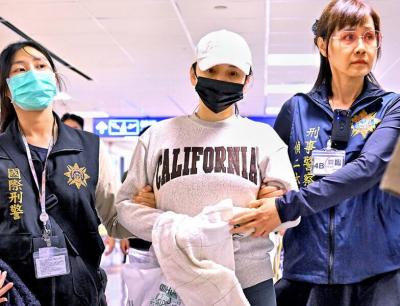
Johanne Liou (劉喬安), a Taiwanese woman who shot to unwanted fame during the Sunflower movement protests in 2014, returned to Taiwan last night after being deported from the US. She is to stand trial in Taiwan for charges involving embezzlement, fraud and drug crimes. The Criminal Investigation Bureau (CIB) said it took her into custody at Taiwan Taoyuan International Airport and would first question her before transferring her to the New Taipei District Prosecutors’ Office. She was arrested upon disembarking a flight from San Francisco that landed shortly before 7pm. Liou absconded to the US in 2019 after jumping bail


 RSS
RSS